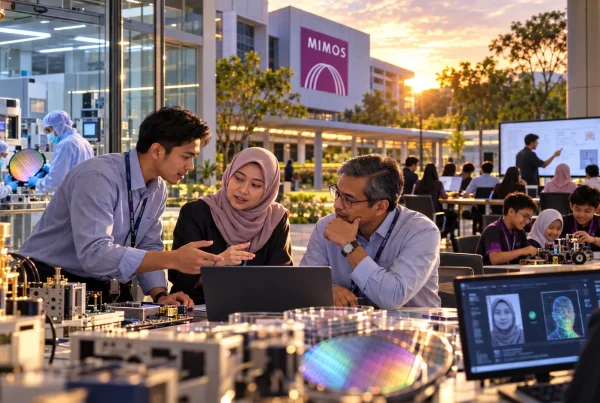

Traditional IP commercialisation models often underperform because research institutions tend to prioritise publications and patent filings over market outcomes. Without structured pathways linking R&D outputs to real market demand, a large proportion of innovations remain uncommercialised.
Many studies suggest that only a small share of research outputs, estimated at below 10%,successfully reach commercial application. This is not necessarily due to weak technology, but rather to systems not being designed with commercialisation as a primary objective.
The Core Problem: The Research–Market Gap
Innovation pipelines have historically ignored commercial outcomes. By incentivising researchers to publish and patent rather than solve market problems, organisations end up with labs full of breakthroughs that stay trapped in the building.
This is a structural failure, not a lack of talent. Without deliberate pathways to the market, even the best innovations stagnate, leaving organisations to effectively fund their competitors’ success. To bridge this gap, organisations must focus on a new standard of IP Bankability.
What is IP Bankability?
IP Bankability is the capacity of an intellectual asset to secure investment, drive steady revenue, and function as a financially viable, scalable product. A bankable IP asset is typically one that addresses a validated market need, is supported by strong and defensible protection mechanisms, and is aligned with a clear commercialisationor licensing pathway. In addition, such assets demonstrate the potential to scale across multiple applications or markets, enabling broader adoption and long-term value creation.
How is MIMOS addressing the research-market gap?
MIMOS designs IP with commercial outcomes from the start, by integrating market research, stakeholder engagement, and strategic licensing into the innovation process rather than treating commercialisation as an afterthought. MIMOS defines bankable IP as intellectual property structured to attract investment, generate returns, and withstand market scrutiny.
The Market Reality: IP Portfolios as Competitive Weapons
Today’s most competitive industries are not fought on product features alone, but they are fought on IP portfolio depth. Pharmaceutical companies license compounds. Tech companies cross-license patents to avoid litigation. Platform businesses use proprietary algorithms as moats.
The organisations winning this game share a common trait: they build IP with bankability in mind from day one by asking not just “can we protect this?” but “can we monetise this, license this, or attract investment with this?”
Are patents still important for IP strategy?
Yes, but only as one component. A comprehensive IP strategy also includes trademarks, trade secrets, brand equity, and licensing structures. Patents protect the broader strategy monetises. Organisations that treat patent filing as the end goal consistently underperform those who integrate patents into a full commercial IP system.
What industries are most affected by ineffective IP commercialisation?
Technology, healthcare, agriculture, and advanced manufacturing are the most impacted sectors, and all sectors where the research-market gap is widest and where MIMOS is actively building bankable IP solutions. These industries share long development cycles, high R&D costs, and complex regulatory environments that make structural commercialisation pathways essential.
MIMOS Historical IP: A Foundation for Commercial Impact
Since 1985, MIMOS has developed a substantial public-sector IP portfolio in Malaysia across multiple technology domains, contributing to national innovation and digital development.
Key Terms: IP Commercialisation Glossary
The degree to which an IP asset can attract investment, generate revenue, or be structured as a financially viable instrument.
The process of converting intellectual property into market-ready products, services, licenses, or investable assets.
The full collection of a company's intellectual property assets, including patents, trademarks, copyrights, trade secrets, and know-how.
The structural disconnect between academic/R&D innovation outputs and the commercial requirements needed for market adoption.
1985–1999: Semiconductor & Hardware
- IC design methodologies
- Embedded systems architecture
- Hardware acceleration
- Computing infrastructure backbone for Digital Malaysia
2010–2017: Cybersecurity & Cryptography
- PKI systems
- Digital identity frameworks
- Encryption algorithms
- e-Government and financial sector deployment
2000–2009: Networking & Wireless
- Wireless LAN protocols
- IPv6 transition technology
- Broadband access systems
- Network security frameworks
2018–2022: AI & Data Intelligence
- ML models for agriculture
- Natural Language Processing (NLP) for Bahasa Malaysia
- IoT analytics
- Predictive maintenance systems
2023–Present: Sustainable Computing and Digital Platform Technologies
MIMOS’ current focus includes sustainable computing architectures, AI-driven resource optimisation, and cross-sector digital platform intellectual property, representing areas of emerging innovation with potential commercial application.
Major Commercialisation Milestones
1995
2001
2006
2011
2014
2017
2020
2023
MIMOS’ IP record is not simply an institutional archive, it is commercial proof. Every milestone represents IP that survived the most demanding test of bankability: real-world adoption by industry, government, and international partners.