By Ts. Dr. Anis Suhaili Bakri,
Senior Staff Engineer, Failure Analysis, MIMOS Berhad
Picture this: Your production line just stopped. Your latest product batch is failing, and every minute of downtime is costing you thousands. You desperately need answers, so you rush to get one quick analysis done, hoping it will solve everything. But here is the harsh reality, relying on just one analysis is like trying to solve a murder case with only one fingerprint. You might get a clue, but you will never get the complete story.
Think about it. When your doctor suspects something serious, do they rely on just one test? Of course not. They run multiple tests, cross-reference results, and build a complete picture before making a diagnosis. The same logic applies to understanding why your materials, components, or products are failing. One analysis equipment simply cannot capture all the complex interactions happening at the microscopic level.
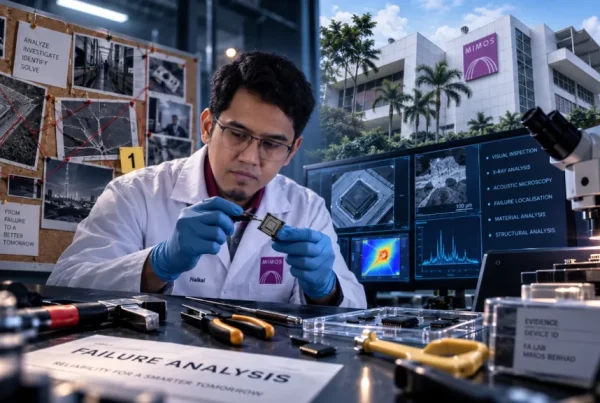
This is exactly why the MIMOS Failure Analysis and Material Analysis Laboratory has become Malaysia’s premier one-stop centre for solving the most challenging technical problems. Thanks to Malaysia’s strategic investment through the RMK (Malaysia Plan) funding, we now house over 30 cutting-edge analytical instruments under one roof, many of which you will not find anywhere else in Malaysia. Our arsenal includes cutting-edge tools like Time-Of-Flight-Secondary Ion Mass Spectrometry (ToF-SIMS), Auger Electron Spectroscopy (AES), 300 kV Transmission Electron Microscope (TEM), Optical Photothermal Infrared spectroscopy (OPTIR), and windowless Energy Dispersive Spectroscopy (EDS) systems. But having expensive equipment is not enough, it is how we use them together that makes all the difference.
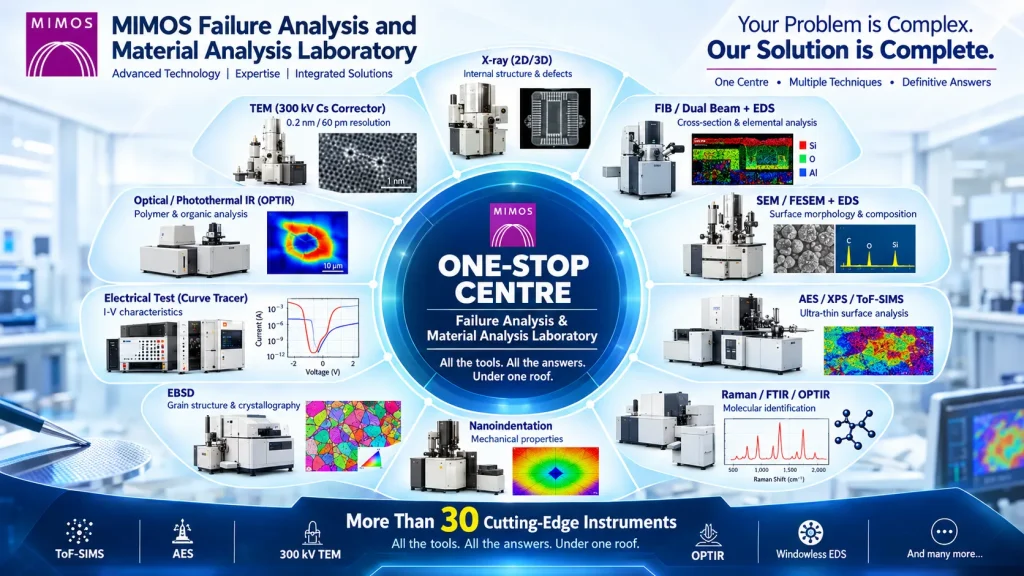
Let’s walk through a typical investigation. We always start with the big picture using our 2D and 3D X-ray systems. Think of it as getting a full-body scan before surgery. This non-destructive testing gives us the overall health of your component without damaging it. Then we move to electrical fingerprinting using our curve tracers with variable specifications that can handle everything from delicate logic circuits to high-power devices. Each product gets precision-tailored testing parameters because one size definitely does not fit all.
But here is where things get really interesting, finding the exact location of your problem. Whether you are dealing with short circuits, leakage current issues, or resistive failures, we have specialised hot spot localisation tools that work like GPS for defects. Our PEM system pinpoints leakage problems, while OBIRCH technology precisely locates resistive failures. It is literally like having navigation technology for your defects, we can tell you exactly where the problem started and how it spread.
Once we have located the ‘crime scene,’ we become surgical detectives. Our dual-beam and plasma FIB systems can cut through your components with nanometre precision, revealing what is actually happening inside. We can expose internal cracks, delamination, and material diffusion issues, and determine the precise elemental composition using our attached EDS systems. But what if the defect is incredibly tiny, below 10 nanometres or in ultra-thin layers? That is where our Transmission Electron Microscopy (TEM) system demonstrates its strength, delivering a spatial resolution of 0.2 nm and magnifications of up to 1,000,000×, enabling atomic-scale characterization. And with our new 300 kV TEM with Cs corrector, we manage to achieve an astounding 60 picometer resolution. That is smaller than most atoms!
Now, here is a scenario that happens more often than you would think. Your EDS analysis shows elevated carbon, hydrogen, nitrogen, and oxygen levels, suggesting contamination. Most would stop there, thinking they have their answer. But here is the problem, EDS penetrates 1-3 micrometres deep based on Monte Carlo simulations. What if your contamination is only 2-4 nanometres thick on the surface? You would completely miss the real culprit! This is where our surface-sensitive analytical techniques become game-changers. Our AES, X-Ray Photoelectron Spectroscopy (XPS), and ToF-SIMS systems can detect contamination at the nano-scale level, choosing the right technique based on contamination concentration, depth, and defect size.
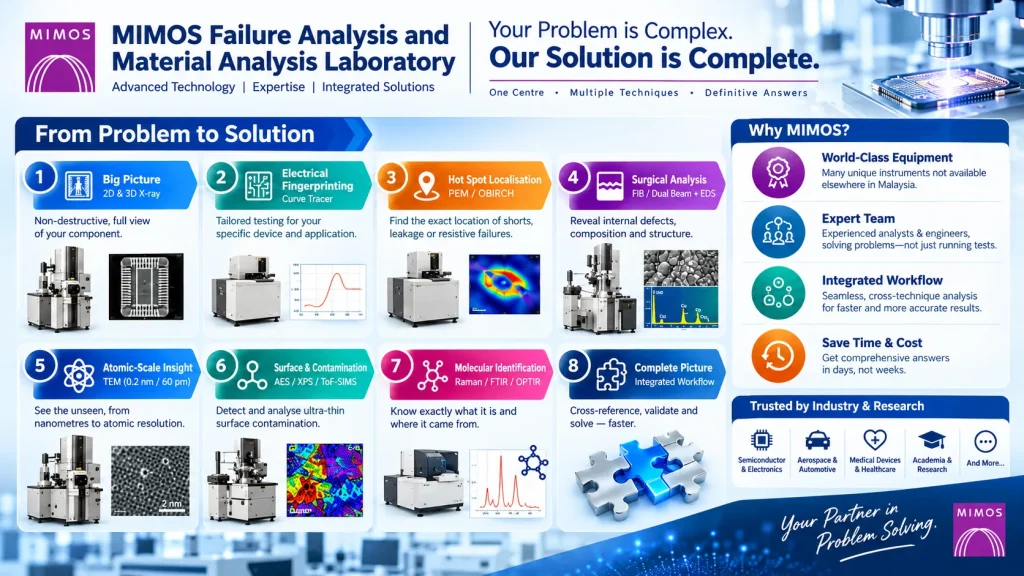
But wait, there is more to the story. Detecting higher carbon levels is one thing, but what exactly IS that carbon? Is it from fingerprints, process oils, cleaning residues, or something else entirely? This is where our molecular identification tools become absolutely crucial. Our Raman spectroscopy, FTIR, and OPTIR systems, all equipped with comprehensive ‘Know It All’ databases, can tell you exactly what type of contamination you are dealing with. Instead of just telling you there is oil on your leadframe, we reveal the specific type of contaminant and trace it back to the exact step in your process where it occurred.
What makes MIMOS truly different is that everything is under one roof. Imagine the typical scenario: you send samples to Lab A for X-ray analysis, wait two weeks, then send to Lab B for chemical analysis, wait another two weeks, then to Lab C for surface analysis. By the time you get all the results six weeks later, you have lost production time, money, and possibly market share. Worse yet, each lab analyses in isolation, potentially missing vital connections between different findings.
At MIMOS, our integrated approach means your sample moves seamlessly from one analysis to another, with our experts continuously building on previous findings. When the X-ray shows a suspicious area, we immediately move to hot spot localisation. When we find the defect location, we instantly proceed to cross-sectional analysis. When we detect contamination, we immediately identify its molecular composition. This integrated workflow can compress weeks of analysis into days, saving you both time and money while providing far more comprehensive results.
Our team does not just run individual tests, we are solving puzzles. We understand how different analytical techniques complement each other, ensuring you get the most strategic analysis approach for your specific problem. We have helped countless companies identify root causes, implement corrections, and prevent future failures. More importantly, we have helped them get back to production faster and with greater confidence in their solutions.
The bottom line is simple:
Your complex problems deserve comprehensive solutions. Avoid production downtime and bottom-line losses while waiting on fragmented answers from multiple vendors. At the MIMOS Failure Analysis and Material Analysis Laboratory, we believe that the right combination of advanced equipment, integrated workflows, and expert interpretation can solve almost any technical challenge. Your problem is not just a number to us, it is a puzzle we are excited to solve, and we have all the pieces under one roof to solve it completely.
Ready to experience what comprehensive failure analysis can do for your business? Contact MIMOS Failure Analysis and Material Analysis Lab today, because your problem deserves more than just one answer, it deserves the complete solution.