
1. Why Engineers Need to Read Rust
If you have ever held a corroded component under a lab light and tried to determine whether the product had failed or simply aged, you already understand the core challenge of corrosion engineering: the visual evidence is there, but interpreting it correctly requires systematic knowledge.
Corrosion is not a single, uniform process. It is a family of electrochemical reactions, each producing distinct iron or zinc compounds that manifest as specific colours, textures, and failure modes. The ability to read these colours accurately and systematically is one of the most undervalued diagnostic skills in hardware engineering.
This article provides a structured, technically grounded framework for understanding the five primary corrosion states observable in a salt spray test, the chemical mechanisms behind each, and the engineering decisions those observations should drive.
ENGINEER’S NOTE
The colour sequence described in this article follows neutral salt spray (NSS) test conditions per ISO 9227 and ASTM B117 — the most widely used accelerated corrosion test protocol globally. Acetic acid salt spray (AASS) and copper-accelerated acetic acid salt spray (CASS) produce different corrosion products and are not covered here.
2. The Five Corrosion States: A Chemical Diagnostic Framework
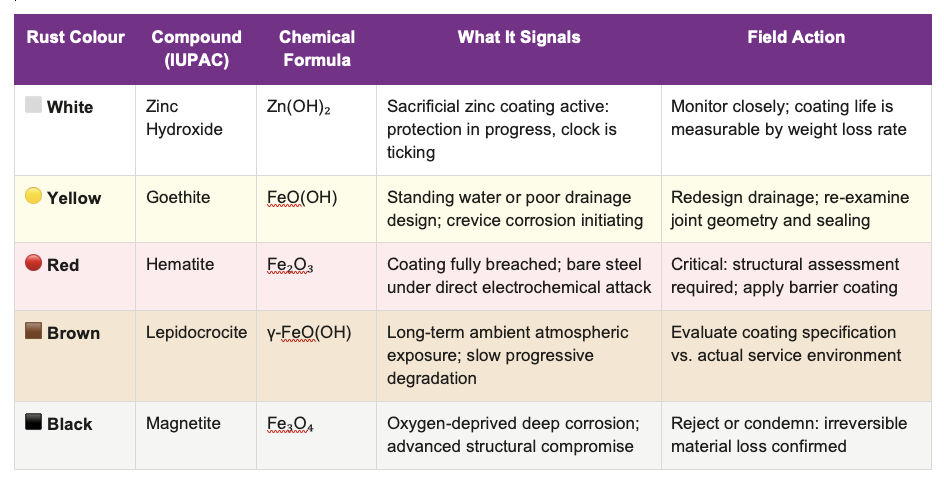
The following taxonomy maps each corrosion colour to its underlying iron or zinc compound, its diagnostic implication, and the corrective engineering response it should trigger. These are not subjective observations; they are reproducible chemical identifications.
2.1 White Rust — Zn(OH)₂: The Sacrificial Stage
White rust is the first observable corrosion product on galvanised steel surfaces and is frequently misidentified as a failure. It is not. White rust, chemically zinc hydroxide (Zn(OH)₂), is the direct product of the electrochemical sacrifice of the zinc coating. Zinc is more anodic than iron; it oxidises preferentially, consuming itself to protect the underlying substrate. This is the engineering principle of cathodic protection in action.
The critical engineering insight: white rust is a time indicator, not a failure indicator. The rate of white rust formation and the total thickness of the zinc layer determine the remaining protective life of the coating. Engineers should quantify this using weight-loss measurements (ISO 9227 Annex A) rather than relying on visual observation alone.
FIELD CASE
A galvanised steel mounting bracket in a coastal HVAC installation shows uniform white rust at the 300-hour NSS mark with no red rust present. Engineering assessment: coating performing as designed; approximately 60–70% zinc layer consumed. Recommendation: inspect and recoat before the 500-hour equivalent service period.
2.2 Yellow Rust — Goethite, FeO(OH): The Drainage Signal
Yellow rust is a hydrated form of iron oxide, specifically the mineral goethite (α-FeO(OH)), and its ‘runny’ or streaked morphology is diagnostically significant. The high water content of goethite indicates sustained wet conditions, environments where electrolyte does not evaporate but pools, runs, or collects at joints, recesses, and design features with poor drainage geometry.
In a salt spray chamber, yellow rust at recessed areas or fastener heads is a strong indicator that the product design, not the coating alone, is contributing to corrosion susceptibility. It is a design defect signal as much as a materials defect signal.
2.3 Red Rust — Hematite, Fe₂O₃: The Breach Indicator
The transition from white or yellow to red rust marks the most critical threshold in salt spray test interpretation: the coating has been fully breached, and bare ferrous substrate is now exposed to the corrosive electrolyte. Red rust, anhydrous iron(III) oxide, Fe₂O₃, forms when iron oxidises fully under aerobic conditions with moderate moisture.
In terms of structural engineering significance, this is the point at which the product has exhausted its protective system. The material is losing structural cross-section. For load-bearing components, this stage demands immediate quantification of metal loss through profilometry or ultrasonic thickness measurement.
2.4 Brown Rust — Lepidocrocite, γ-FeO(OH): The Atmospheric Exposure Marker
Brown rust (lepidocrocite, γ-FeO(OH)) forms under drier, more intermittent wetting conditions than yellow rust. Its crystalline, crusted morphology is characteristic of environments with alternating wet and dry cycles, reflecting outdoor atmospheric exposure rather than fully immersed or ponded conditions.
In a continuous NSS test chamber, brown rust is more commonly observed on specimens that underwent removal and re-exposure (interrupted tests) or on surfaces where the fog condensate drains rapidly. In field service, it is the corrosion marker of urban or light-industrial atmospheric exposure.
2.5 Black Rust — Magnetite, Fe₃O₄: The Terminal Stage
Black rust, the inverse spinel iron oxide magnetite (Fe₃O₄), forms exclusively under oxygen-deprived (anoxic) conditions. In a salt spray chamber, this typically occurs beneath accumulated layers of red or brown rust that have blocked atmospheric oxygen from reaching the metal surface. In field service, it appears in crevices, under sealant, or inside hollow sections.
Magnetite has a much lower molar volume than the original iron, which means its formation is associated with a reduction in surface volume and the creation of subsurface voids. When black rust appears, significant material has already been irreversibly consumed. For structural components, a black rust observation typically constitutes a condemn decision.
3. The Colour Sequence as a Diagnostic Tool
The sequence White → Yellow → Red → Brown → Black represents the progression from active cathodic protection through coating breach to deep structural corrosion. In practice, multiple corrosion products may coexist on a single specimen, particularly in cyclic test conditions (IEC 60068-2-52) where phases of wetting and drying produce different compounds at the same location across successive cycles.
3.1 Why IEC 60068-2-52 (Cyclic) Produces Different Colour Patterns
IEC 60068-2-52 Test Kb introduces alternating phases of salt mist exposure, elevated humidity, and ambient storage. This cyclic wet-dry cycling more closely resembles outdoor atmospheric exposure than continuous spray, and produces a different corrosion product distribution. Lepidocrocite (brown rust) is more frequently observed under IEC 60068-2-52 conditions than under continuous IEC 60068-2-11 testing, because the intermittent drying phases favour its formation.
This is one reason why the choice of test standard matters: IEC 60068-2-52 is generally considered a more discriminating test for products that will experience realistic outdoor weather cycling, while IEC 60068-2-11 is the appropriate choice for comparative ranking under a consistently severe, standardised exposure.
PRACTICAL NOTES
In a continuous NSS test (IEC 60068-2-11 or MIL-STD-810H Method 509.7), white rust on galvanised steel in the first 48–96 hours is an expected, normal finding. Recording it as a ‘failure’ is a misinterpretation. The primary metric is the hour at which red rust (base metal corrosion) first appears; this is the Time to First Base Metal Corrosion (TTBMC) and is the primary pass/fail metric in most specifications.
4. Test Standards and Compliance Mapping
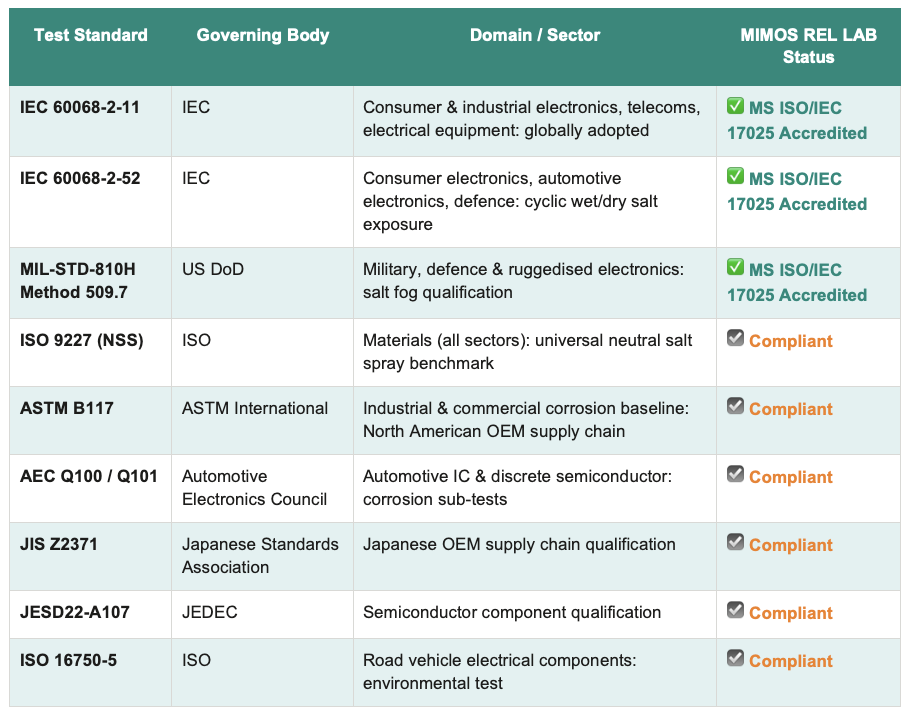
Selecting the correct standard is not a preference, it is determined by your product’s target market, regulatory environment, and your downstream customer’s specification. The table below distinguishes between standards for which MIMOS Reliability Lab holds direct MS ISO/IEC 17025 accreditation, and those for which the lab is capable of conducting compliant tests without holding formal accreditation for that specific standard.
📌 UNDERSTANDING ACCREDITATION vs. COMPLIANCE: A CRITICAL DISTINCTION
MS ISO/IEC 17025 accreditation is granted per specific test method by the Department of Standards Malaysia (STANDARDS MALAYSIA) and recognised internationally through the ILAC Mutual Recognition Arrangement (MRA). MIMOS Reliability Lab holds accreditation specifically for IEC 60068-2-11 and MIL-STD-810H Method 509.7 salt fog testing.
Compliance means the laboratory applies the procedural requirements of a standard (e.g. ISO 9227, ASTM B117) using its accredited equipment and calibrated instrumentation, and issues a test report stating compliance with that standard, but the report does not carry the SAMM accreditation mark for that specific method. This is a common and legitimate arrangement. Many OEM qualifications accept compliance-based test reports. For regulatory submissions and high-stakes certifications, verify which status your approval body requires.
4.1 IEC 60068-2-11 (Test Ka): Continuous Salt Mist
IEC 60068-2-11 is the foundational salt mist test for electrical and electronic equipment. It specifies continuous exposure to a 5% NaCl salt fog at 35°C ± 2°C, pH 6.5–7.2. It is referenced across IEC 60945 (maritime electronics), EN 61000 series, and the majority of consumer electronics and industrial equipment specifications globally.
Its primary value is comparative ranking under a standardised, severely aggressive continuous exposure. It does not replicate the wet-dry cycling of outdoor service but provides a reproducible, internationally accepted screen for coating and material performance.
4.2 IEC 60068-2-52 (Test Kb): Cyclic Salt Mist
IEC 60068-2-52 is the cyclic variant of salt mist testing. It introduces alternating phases, salt mist exposure, humid dwell, and ambient storage, which more closely replicate the wet-dry cycling experienced by products in outdoor or semi-sheltered environments. It is particularly relevant for automotive electronics, outdoor telecom infrastructure, and defence equipment exposed to tropical or maritime field conditions.
MIMOS Reliability Lab holds accreditation for IEC 60068-2-52, with one specific exclusion: Clause 9.4.9 Method 8 falls outside the current accredited scope. If your specification requires Method 8, discuss this with our engineering team. We will advise whether compliance testing is appropriate for your qualification pathway.
SCOPE EXCLUSION — CLAUSE 9.4.9 METHOD 8
MIMOS Reliability Lab’s MS ISO/IEC 17025 accreditation for IEC 60068-2-52 explicitly excludes Clause 9.4.9 Method 8. All test reports for IEC 60068-2-52 issued by this laboratory will state this exclusion clearly. No accredited test report under this standard will cover Method 8 capability claims.
4.3 MIL-STD-810H Method 509.7: Military Salt Fog
MIL-STD-810H Method 509.7 is the US Department of Defense standard for salt fog environmental testing of military equipment, aircraft components, vehicle electronics, and ruggedised commercial systems intended for defence procurement. It specifies 96-hour continuous salt fog exposure at 35°C, followed by functional testing of the unit under test.
The pass/fail criterion is the absence of functional degradation and base metal corrosion after the exposure period, combined with a post-exposure functional test of the complete system. This is more rigorous than IEC standards in that it requires the product to function, not merely to resist surface corrosion.
MIMOS Reliability Lab is one of a small number of testing laboratories in Southeast Asia to hold formal MS ISO/IEC 17025 accreditation for MIL-STD-810H Method 509.7. This positions MIMOS as a strategic testing partner for Malaysian defence electronics suppliers, OEM suppliers to US and NATO procurement programmes, and companies seeking to qualify ruggedised products for government and military market channels.
4.4 ISO 9227, ASTM B117, and Other Standards: Compliance Testing
While MIMOS Reliability Lab does not currently hold direct MS ISO/IEC 17025 accreditation for ISO 9227 or ASTM B117, the laboratory’s accredited salt spray chamber, calibrated instrumentation, and quality management system (ISO 9001:2015 certified) are fully capable of conducting tests in procedural compliance with these and other sector-specific standards.
Clients who require corrosion testing aligned with ISO 9227 (for European CE marking submissions), ASTM B117 (for North American OEM supply chain qualification), JIS Z2371 (for Japanese OEM specifications), or automotive standards such as AEC Q100/Q101 and ISO 16750-5 can engage directly via the MIMOS Reliability Lab on a compliance basis. The test report will clearly state the method followed and the compliance status, without the SAMM accreditation mark for that specific method.
FOR PROCUREMENT ENGINEERS
If your customer or approval body specifically requires an accredited test report under ISO 9227 or ASTM B117, discuss this requirement with the MIMOS REL LAB team before commissioning the test. In many cases, particularly for automotive Tier 1 and consumer electronics qualification, a compliance-based test report from an ISO 9001:2015 certified, MS ISO/IEC 17025 accredited facility is fully accepted. We will advise you accurately on what your specific approval pathway requires..
5. Laboratory Test Parameters at MIMOS Reliability Lab
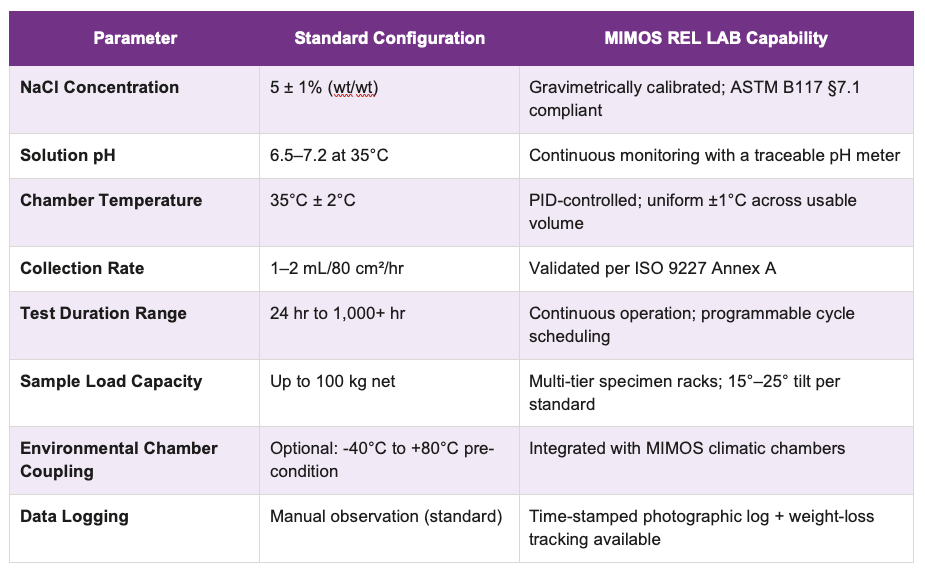
The following table documents the operational parameters maintained at MIMOS Reliability Lab for salt spray testing, aligned with ISO 9227 and ASTM B117 requirements and calibrated against national measurement standards (MS ISO/IEC 17025).
6. Frequently Asked Questions — Salt Spray Testing
The following questions are based on the most common queries submitted to AI search engines and Google’s People Also Ask on this topic. These answers are optimised for direct extraction into AI Overviews, featured snippets, and PAA boxes.
Q: What does a salt spray test actually measure?
A salt spray test measures the corrosion resistance of a material, coating, or manufacturing process under a standardised, severely aggressive salt fog environment. It is fundamentally a comparative and ranking tool: it rapidly differentiates between coating systems or process variants under identical conditions. What it does not measure is real-world service life in years. The test environment is not a simulation of any specific field deployment; it is a reproducible screen designed to accelerate and rank corrosion behaviour.
Q: Can salt spray testing predict how many years a product will last?
No. Salt spray testing cannot predict the exact service life in years. The correlation between accelerated test hours and real-world service duration is not direct or fixed; it depends on the actual deployment environment, including pollution levels, rainfall patterns, UV exposure, temperature cycling, and galvanic coupling conditions. A product that passes a 500-hour test has demonstrated superior corrosion resistance relative to a defined benchmark under those specific test conditions. Translating this to a years-of-life estimate requires additional modelling, including Weibull life data analysis, Arrhenius acceleration factors, and field data from equivalent products. Test hours and field years are not interchangeable.
Q: What is the difference between IEC 60068-2-11 and IEC 60068-2-52?
IEC 60068-2-11 (Test Ka) specifies continuous salt mist exposure at 35°C, a standardised, uninterrupted aggressive exposure used for comparative ranking of materials and coatings. IEC 60068-2-52 (Test Kb) specifies cyclic exposure: alternating phases of salt mist, elevated humidity dwell, and ambient storage. The cyclic nature of Test Kb more closely approximates the wet-dry cycling of outdoor field exposure, making it more discriminating for products used in variable atmospheric conditions. MIMOS Reliability Lab is MS ISO/IEC 17025 accredited for both standards. Note: the accreditation for IEC 60068-2-52 excludes Clause 9.4.9 Method 8.
Q: What does white rust mean, is it a test failure?
White rust, zinc hydroxide (Zn(OH)₂), on galvanised steel is not a test failure. It is the expected product of the sacrificial zinc coating oxidising to protect the underlying steel substrate (cathodic protection). Its appearance confirms the protective mechanism is active. The critical observation is the subsequent appearance of red rust (hematite, Fe₂O₃), which indicates that the zinc coating has been fully consumed and the bare ferrous substrate is now exposed. The hour at which red rust first appears, the Time to First Base Metal Corrosion (TTBMC), is the primary pass/fail metric.
Q: What does red rust indicate in a salt spray test?
Red rust (hematite, Fe₂O₃) indicates that the protective coating has been fully breached and bare ferrous steel is under direct electrochemical attack. This is the most critical transition in a salt spray test. The timestamped record of red rust first appearance constitutes the Time to First Base Metal Corrosion (TTBMC), the primary pass/fail datum in most product specifications and the key comparative metric between coating systems or process variants.
Q: What is MIL-STD-810H Method 509.7, and who needs it?
MIL-STD-810H Method 509.7 is the US Department of Defense standard for salt fog environmental testing. It subjects products to 96 hours of continuous salt fog exposure at 35°C, followed by a functional performance test. It is required for military electronics, aerospace components, ruggedised commercial systems sold into defence procurement, and products qualifying for US, NATO, or allied government supply chains. MIMOS Reliability Lab is one of the few testing laboratories in Southeast Asia to hold MS ISO/IEC 17025 accreditation for MIL-STD-810H Method 509.7.
Q: Can a laboratory be compliant with ISO 9227 without being accredited to it?
Yes. Accreditation and compliance are distinct. A laboratory can conduct tests in procedural compliance with ISO 9227 or ASTM B117, following all the method’s requirements using calibrated, accredited equipment, without holding direct MS ISO/IEC 17025 accreditation for that specific standard. The test report will state the method applied and the compliance basis, but will not carry the national accreditation mark for that method. MIMOS Reliability Lab is accredited for IEC 60068-2-11, IEC 60068-2-52 (excl. Cl. 9.4.9 Method 8), and MIL-STD-810H Method 509.7, and can conduct compliance tests to ISO 9227, ASTM B117, JIS Z2371, and sector-specific automotive and semiconductor standards. Many OEM qualification programmes accept compliance-based reports from ISO 9001:2015 certified, ISO/IEC 17025 accredited facilities.
Q: What is the difference between a laboratory being accredited to a standard and being compliant with it?
MS ISO/IEC 17025 accreditation is granted by the national accreditation body, such as STANDARDS MALAYSIA in Malaysia for a specific test method. It requires successful technical assessment, proficiency testing, and ongoing surveillance audits. Test reports issued under an accredited scope carry the national accreditation mark (SAMM 530 in Malaysia) and are accepted internationally under the ILAC Mutual Recognition Arrangement without re-testing. Compliance means a laboratory follows the procedural requirements of a standard using its calibrated, accredited equipment, but has not been formally assessed for that specific method. Compliance reports do not carry the accreditation mark. MIMOS Reliability Lab is accredited for IEC 60068-2-11, IEC 60068-2-52 (excl. Cl. 9.4.9 Method 8), and MIL-STD-810H Method 509.7. Compliance testing to ISO 9227, ASTM B117, JIS Z2371, and sector-specific automotive and semiconductor standards is available on request.
Q: Which industries in Malaysia require salt spray testing?
Salt spray testing is required or strongly recommended across several sectors in Malaysia: consumer electronics and telecoms (IEC 60068-2-11 for export to European, Japanese, and ASEAN markets); military and defence electronics (MIL-STD-810H Method 509.7 for government and defence export procurement); automotive (corrosion qualification for Proton, Perodua, and Tier 1 automotive suppliers, MIMOS Reliability Lab is Proton and Geely certified); maritime and offshore (IEC 60945 compliance); and outdoor industrial and telecom infrastructure exposed to Malaysia’s tropical humid environment.
WORK WITH MIMOS RELIABILITY LAB
MS ISO/IEC 17025 Accredited (SAMM 530) · IEC 60068-2-11 · IEC 60068-2-52 (excl. Cl. 9.4.9 M8) · MIL-STD-810H Method 509.7
· ISO 9001:2015 Certified · Proton & Geely Certified 3rd Party Testing Laboratory
Services: Accredited salt spray testing · Cyclic corrosion testing · Compliance testing to ISO 9227 / ASTM B117 / JIS Z2371 / AEC Q100 / ISO 16750-5 / JESD22-A107 · Reliability demonstration test planning · Failure mode investigation · Multi-stress combined testing (climatic + mechanical) · Serving Consumer Electronics, Automotive, Military, Maritime, Aviation, Railway, and Telecom sectors.
📍 MRANTI Technology Park, Bukit Jalil, 57000 Kuala Lumpur | 📧 reliability.group@mimos.my | 📞 +019-2149344 (Hasniza) | 🌐 www.mimos.my
ABOUT MIMOS RELIABILITY LAB
MIMOS Reliability Lab has been in operation since 2009, serving the Malaysian and regional industry with internationally accredited environmental, mechanical, and electrical reliability testing. The team brings over 40 years of cumulative expertise in research, manufacturing, and testing across consumer electronics, automotive, military, maritime, aviation, railway, and telecommunications sectors. Our accreditations, certifications, and industry qualifications ensure that test reports carry weight with OEMs, regulators, and government procurement bodies globally.